
Botswana Safari By Aircraft

Discover the Breathtaking Beauty of Botswana from the Sky: An Unforgettable Aerial Adventure Over the Okavango Delta and Beyond
Some people are nervous about heights; some are agoraphobic; my particular phobia is flying. Upon discovering that I would have to endure two 'big' and four 'little' planes over a period of just four days, a cold sweat came over me, which was slightly relieved when I discovered that we would be in one of the bigger Caravans instead of the much smaller Cessna’s.
While these light aircraft weren't built to be spacious, the 12-seater Caravans are more comfortable and less claustrophobic than the Cessna’s, which are either 4 or 6-seaters. The planes used to depend on the number of travellers. The Caravans also offer a slightly smoother ride, but the general rule is: if you're prone to motion sickness, sit up near the front as you won't feel the thermals as much.

As we slowly took off from Maun International Airport (don’t be thrown by the "International" part, Sunday afternoons at a ladies bridge club are busier) I sat there white-knuckled and pale-faced. After a while a strange thing happened, I started to feel comfortable. Martin, our very experienced and friendly pilot definitely eased the nerves, but I also found myself distracted by my surroundings: the little clay buildings dotted around the centre of Maun (which really is a tiny little town,) the huge amount of cattle and the full Thamalakane River which feeds from the Boro River, one of the main channels of the Okavango Delta.

This was my first time seeing Botswana from the air, and it helped put the scenery into perspective for me. Not only was the landscape impressive, especially flying over the Savute Marsh and the magnificence of the whole of the Okavango Delta, but I also saw abundant wildlife, including elephant, giraffe, and hippo fresh out of the water (which turned out to be the only hippo we saw in the whole trip).

By the time our safari had ended, and I found myself on Terra firma back at Maun Airport. I was already dreaming up my next safari and realising how much I had enjoyed my time, especially in the 'little' planes. The whole Botswana experience is a bucket-list contender, and I recommend it to everyone; the young and the 'mature'.
I certainly will be back to visit Botswana by Air again.
Travel To Botswana Now
Map of Lodges in and around Botswana
Lodges And Camps In Botswana

Duke's Camp
Duke's Camp is a luxurious safari lodge located in the heart of Botswana's Okavango Delta, providing guests with an ultimate African experience. This exclusive camp is named after Sarefo 'Duke' Sarefo and consists of eight lavish safari suites set among raised wooden decks beneath a canopy of ebony and leadwood trees. Expert safari guides will take you on exciting game drives and mokoro cruises through the Okavango Delta to uncover its hidden secrets and explore its abundant wildlife.
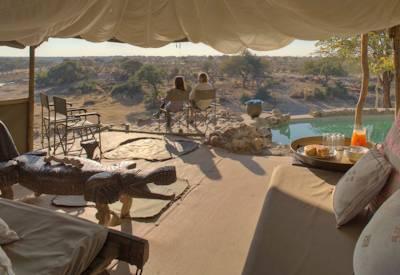
Meno a Kwena
A hidden gem of a camp perched on a rocky clifftop above the Boteti River and overlooking the Makgadikgadi Pans National Park. If you're looking for an amazing safari experience that is off the beaten path, Meno a Kwena should be at the top of your list. Whether you're a fan of wildlife viewing or just want to relax and take in the amazing night stars, Meno a Kwena Camp is definitely worth considering for your next safari in Botswana.

Kings Pool Camp
Kings Pool Camp in the Linyanti Wildlife Reserve offers up nine of the most luxurious safari suites in the whole of Botswana; overlooking Kings Pool Lagoon, each suite has its own private plunge pool and a sala. Kings Pool Camp is one of the best Linyanti bush camp options; yes, expensive, but oh so worth it in every way possible.

Stanleys Camp
Stanley’s Camp is an intimate safari retreat featuring just 8 exquisitely designed luxury tents, each radiating a classic charm that perfectly complements the surrounding wilderness. Set within an exclusive 260,000-acre concession, this camp offers a front-row seat to some of Africa’s most iconic wildlife. The wildlife sightings here are truly exceptional and include everything from giraffes and hippos to the elusive wild dogs, making it a haven for nature enthusiasts.

Duba Explorers Camp
Duba Explorers Camp is a wonderful safari camp that offers luxurious accommodations. It can be found in the Duba Plains Concession, which is a privately-owned reserve measuring 33,000 hectares. The private Concession is situated in the pristine Okavango Delta region of Botswana. Explorers Camp offers breathtaking views of permanent floodplains, seasonal floodplains, grasslands and pockets of mopane and acacia woodlands. Visitors can stay in only five tented safari suites and enjoy a range of activities from game drives, bush walks, bird watching or fishing trips.

Savute Safari Lodge
The 12 safari suites at Savute Safari Lodge offer large private viewing decks ideally situated for watching the game at the waterhole; because of the stunning wildlife found within the area, this is one of our more popular Chobe National Park accommodation establishments. Savute Safari Lodge offers one of the best viewing decks in the area; armchair game viewing from the lodge is a must.

Chobe Bush Lodge
Chobe Bush Lodge next to the northern Botswana town of Kasane is the perfect gateway to explore all that this region has to offer; including the safari destinations of Namibia, Zimbabwe, Zambia, Chobe National Park, Chobe River, and Victoria Falls to mention but a few. The lodge is ideally situated for adventures along the Chobe River, where you can enjoy unforgettable wildlife viewing by boat, as well as trips to the iconic Victoria Falls, one of the Seven Natural Wonders of the World.

Chobe Chilwero Lodge
Chobe Chilwero Lodge offers 15 luxury stone & thatched bungalows all offering awe-inspiring scenery as a backdrop; the lodge is bordered by Botswana's famous National Park which is elephant country. A wide range of safari activities awaits, including game drives through the Chobe National Park to spot elephants, lions, and other wildlife, as well as tranquil boat safaris on the Chobe River, offering a unique perspective of the park's rich ecosystems.